Moving Holograms and Performances
© 2024–2026 Ricardo Peredo Wende
The following pictures show still images and videos of installation with moving holograms, prints, drafts, sculptures, drawings and performances, dimensions vary. Berlin, 2024-2026.
Most of the videos—many of them part of installations—can be found on my Vimeo page.
My work is non-commercial.
I’m looking for sponsorship to continue developing my artistic and scientific practice, exploring moving holography in dialogue with performance, painting, drawing, music, and other media.
I use my own artistic intelligence—another form of AI—in the creation of my artwork.
I choose not to use artificial intelligence, as it does not produce the results I seek. Instead, I rely on my own creative vision and process.
Note: This website is designed to be viewed on a computer. It may not display properly on mobile devices, as it contains a variety of detailed images from artworks that require a larger screen for the best experience.
Performance:
Spielen und Malen auf Rollerblades
Vernissage der Dauerausstellung, Kunstraum La Girafe, Berlin
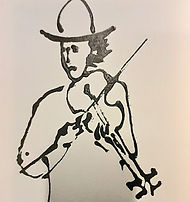
This performance explored the interdependence of drawing, movement, and live musical improvisation. While moving through the space on rollerblades and playing the violin, I continuously drew a line on a canvas. Rather than functioning as separate actions, drawing and playing became mutually generative processes.
The movement enabled by the rollerblades shaped the violin's sound, while the unfolding line on the canvas guided the improvisation and composition of the music. Sound, gesture, and drawing developed simultaneously, each influencing the other in real time. The resulting work was not a fixed composition or predetermined image, but an evolving dialogue in which visual marks and musical expression emerged together through movement.
The performance was realized with the participation of actress Gigi and soprano Lattilia Baronin, whose performative and vocal contributions expanded the dialogue between movement, sound, and visual expression.
Curator: Jaime de la Gracia.
MOVING HOLOGRAM INSTALLATIONS
Most videos include sound. Viewers can activate it using the sound button " Ton an" or "unmute".

Traces in Motion
by Ricardo Peredo Wende
with Nilton Grillo and Gitte Schumacher
Traces in Motion is a 10-minute live multimedia performance that combines violin improvisation, movement, drawing, and projected light.
This work is the result of many years of artistic practice and scientific research in the fields of performance, painting, music, sport, and moving holography in Germany, developed in collaboration with numerous international institutions, including the Museum of Modern Art in Seoul, South Korea; the Museum of Modern Art in La Paz, Bolivia; MIT (USA); the Shaolin Temple; FIU; ifa; bbk; KHM; UdK; GSE; Galerie La Girafe; Kunstraum Reuter; TSC Berlin; and the Centre Français de Berlin in Germany. The performance has just been presented to the Berlin audience at ufaFabrik, Berlin, on 19 July 2026, as part of Berlin C, curated by Dr. Mei Huang.
The central theme of the work is motion in all its forms. The projected rainbow holograms and the sounds of the violin are constantly in movement; the performance itself is driven by motion, while the resulting drawings on paper remain as traces of a ten-minute action. Violin sound frequencies are transmitted to paper by drawing while playing the violin on roller blades.
The sound composition is conceived to be adaptable to different performance contexts whenever possible. Live bass lines amplified through a sound system, together with the signal from my wireless microphone integrated into my violin, can interact with rhythmic beat tracks embedded in the moving hologram video. These elements create a rich and dynamic sonic texture, adding a distinctive electronic and robotic pulse to the performance while preserving its improvisational nature. These technical components are already in place and available for use, so no additional expenses are required. The performance only requires the assistance of a technician during setup and presentation.
Performing on roller blades, I move through the performance space while creating spontaneous violin improvisations. The physical acts of balancing, gliding, and turning become inseparable from the musical composition, transforming movement into sound and sound into movement. Simultaneously, I draw on paper mounted on a board, creating visual traces that emerge in real time as a record of the performance. The drawing functions as a score, a map, and a residue of the body's motion through space.
My artistic work is based on painting, drawing, video art, holography, music, and performance. As a Meisterschüler of Nam June Paik at the Kunstakademie Düsseldorf, I had the opportunity during my art studies at the Kunsthochschule für Medien Köln (Academy of Media Arts Cologne) to learn how to create holograms.
I was particularly interested in producing abstract rainbow holograms and shadow holograms. During the realization of a multimedia installation, I had the good fortune in 1993 to discover “Holofeedback,” a phenomenon in physics that later made it possible for me to create moving holograms by building my own working instruments based on this phenomenon called Holofeedback.
Holofeedback combines video and holography, making it possible to create an analog video feedback with holographic light, thanks to a shadow or rainbow hologram that is used as a filter.
Over time, my instruments and my working technique gradually developed and evolved, becoming increasingly refined. In 2019 I succeeded in constructing my first figurative moving holograms, as until then they had been purely abstract.
Little by little my technique improved until I began to create my first portraits as moving holograms. For the moment these portraits are two-dimensional images, because for technical reasons I start from holographic information derived from two-dimensional rainbow or shadow holograms, combined with video, photography, or drawings.
In my most recent works I presented series of moving hologram portraits at Musikbrauerei and at La Girafe Gallery in the city of Berlin in 2025 and 2026.
As an experiment, I decided to create portraits of public figures and celebrities, as well as friends and acquaintances.
Thanks to the Berufsverband Bildender Künstlerinnen und Künstler Berlin ( BBK Berlin ) and the Berlin Senate for Culture,
I currently have the opportunity to continue researching and developing my artistic work.
I am a bolivian german Berlin-based artist working across interdisciplinary media, exploring the convergence of visual art, sound, and digital processes. My work focuses on artistic research and experimentation with moving holograms and performative practices. It develops through exhibitions, collaborations, and research-based practice.
Rainbow Garden Moving Hologram


“Rainbow Garden Moving Hologram” is a sample from the installation Rainbow Garden Moving Hologram, presented at the Kiezraum Dragonerareal, Berlin, 2025.
These photos are still images from my moving hologram video Moving Hologram Rainbow Garden, produced 2025 and presented in the premiere of my holographic and electronic Cyber Flowers and Blue Eyes moving hologram installation, accompanied by live Latin American music,on the occasion of the Festival of Latin American Music in Berlin, 2025. Dimensions vary. My holographic and electronic Cyber Flowers moving hologram is an abstraction of holographic rainbow flowers in electronic motion.
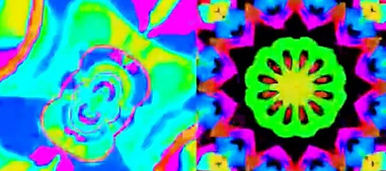
"Naked Eyes 2" moving hologram at the Dragonerarai, Kreuzberg. 2025


Still images from the premiere of my holographic and electronic Cyber Flowers and Blue Eyes moving hologram installation, accompanied by live Latin American music featuring soprano Lattilia Baronin von Ledersteger at Kiezraum Kreuzberg, on the occasion of the Festival of Latin American Music in Berlin, 2025.

The Kiezraum on the Dragonerareal in Berlin-Kreuzberg is a listed former horse stable of the Garde Dragoon Barracks (built around 1855), which today serves as a non-commercial meeting place for neighborhood activities, culture, and community work. After resistance to a planned privatization in 2010, it was developed into a central hub for citizen participation as part of the “Rathausblock” model project, supporting the community-oriented redevelopment of the area.

Moving Hologram Installation in the international exhibition "Dystopie meets Utopie" at the Musikbrauerei. Berlin. 2025
The Musikbrauerei in Berlin’s Prenzlauer Berg (Greifswalder Straße) is a historic industrial monument that was built in the late 1880s as Schneider’s Brewery / Schweizergarten. After the end of wheat beer production around the time of the First World War and a period as an entertainment venue, the dilapidated complex was renovated after German reunification.


Stills from my Moving Hologram Project, produced in 2024, showcasing my technique of playing the violin on rollerblades, Musikbrauerei, Berlin, 2025.


Moving Hologram Installation and Performance by Ricardo Peredo Wende, 2025


Moving Hologram presentation and live grand piano performance at the event "raum: e 30", Musikbrauerei, Berlin, 2025


Stills from my performance inside the moving hologram installation, playing my jazz improvisations and original compositions on the grand piano, wearing a devil’s head hat and a Christmas pullover, Musikbrauerei, Berlin, 2025.

Vimeo video and selected still images of the Geometrical Moving Hologram shown in the event "raum: e 39", Musikbrauerei, Berlin, 2025.


Moving Holograms 2024-2026
A selection of images from my abstract moving holograms, 2025
Soprano Lattilia Baronin von Ledersteger performing in homage to my moving hologram installation, Kiezraum Dragonerareal, Kreuzberg, Berlin, 2025.
Performance work
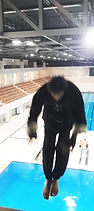
My performance work also seeks to combine moving hologram installations with body motion, music, light, and space, using instruments such as trumpet, violin, mandolin, guitar, piano, keyboard, and voice, together with ice skating, diving, rollerblading, dance, and gymnastics. In this, my work echoes approaches such as Daniel Spoerri’s Eat Art, which integrates everyday actions into art to create new aesthetics. From an art-historical perspective, my diving performances from the 10-, 5-, and 1.5-meter platforms can be understood as a form of sport art, where athletic discipline merges with artistic expression. Within the sports world—particularly in the context of diving in Berlin—trainers and experts tend to remain highly conservative regarding the integration of art, dance, or music. For this reason, the series of realized diving performances will not be repeated. The works continue to exist through the artworks that emerged from them: photographs, video art, and moving holograms. These media were never intended as documentation; they were conceived from the outset as artistic forms that transform the ephemeral movement of the dive into visual works.


Violin Diving Performance Series at Lietzensee on ice skates, at the Velodrom Diving Hall, Berlin, 2025 and Grand Piano Performance in a Museum, Charlottenburg, Berlin, 2024.
Details about my art work
Cinema Performance, Berlin. 2026
I have participated in international exhibitions and projects reprecenting Germany and Bolivia, including Dystopie meets Dystopie at Musikbrauerei Berlin (2025) and exhibition projects at Kunstraum La Girafe, Berlin (2024–2025). My collaborations also extend internationally, including work with Hanmi Gallery in the UK and the National Museum of Art, La Paz in Bolivia.
My practice engages with media art discourse and experimentation. In 2023, I contributed to the international symposium Random Access Sound: ReSounding Nam June Paik at the Seoul National University Museum of Art in South Korea. Earlier, I presented the lecture Mixed Pixels at the Nam June Paik Symposium: The More the Better at the Korean Cultural Center Berlin (2015).
Alongside my artistic work, I have taught workshops and led creative programs, including a workshop on animation with 3D objects at the Academia Nacional de Bellas Artes Hernando Siles in La Paz, Bolivia,
as well as project-based teaching in Berlin.
My current artistic focus lies in the investigation of memory as a point of departure for abstract drawing processes, with the aim of engaging it in an expanded, almost holographic manner. Central to this inquiry is the question of how past sensory experiences—particularly auditory impressions—can be translated into visual form and conceived as multidimensional perceptual spaces.
A key point of reference lies, for example, in a temporally distant experience at the Cité Internationale des Arts in Paris. In memory, the violin sounds of neighbors persist in particular, not as clearly defined musical structures but as spatially extended, continuous movements of sound.
This memory does not appear as a linear sequence, but rather as a diffuse and continuously transforming presence. The notion of the “holographic” serves here as a conceptual model: memory is understood as a dynamic configuration in which fragments circulate and reorganize depending on perspective. In this sense, each perceptual layer potentially contains the structure of a more comprehensive whole. At the same time, I am returning to the primal origins of painting and sculpture through the use of earth and natural pigments, creating works through acts of corporeal inscription that undergo a complex process of transformation and re-elaboration. What begins as a physical trace gradually evolves into sophisticated moving holographic figures, oscillating between material presence and immaterial projection:
Within this framework, drawing operates as a medium of transformation too, translating subjectively perceived “frequencies”—understood as cognitive and sensory resonances—into abstract visual structures. These structures are not conceived as closed forms, but as open, multidimensional configurations that imply movement, depth, and simultaneity.
This approach is further informed by my hologrphic video Cyber Flowers, which serves as an inspiration for the development of a “holographic garden” populated by “holographic flowers,” extending and reinterpreting its visual and conceptual logic into this field of exploration. Past and present, perception and imagination, continuously overlap and reconfigure one another within this process.
Alongside this conceptual framework, my current series of portraits emerges in direct interaction with the same field of inquiry. Rather than functioning as conventional representations of individuals, these portraits operate as sites of resonance in which temporal layers and sensory traces are articulated. Each portrait becomes a surface where perception, memory, and imagined presence converge, echoing the same principles of transformation and simultaneity that structure the holographic approach.




This expanded field of practice also informs my engagement with performance. The performative dimension is not understood as a separate discipline, but as a continuation of the same investigation into time, presence, and perception. It allows the conceptual structures developed in drawing and portraiture to unfold in real time, within a shared spatial and temporal situation.
In this context, teachings and artistic transmissions play a significant role. Certain concise statements encountered during my education—such as the two brief following phrases in the short description of the by Nam June Paik's and Joseph Beuys' portraits—have functioned less as instructions than as condensed conceptual triggers. They operate as minimal scores: open structures that activate thought and performative potential beyond their original context.
Alongside these references, a wider constellation of impressions, encounters, and conceptual fragments continues to inform the development of performative situations. These elements do not form a fixed methodology, but rather an evolving field of impulses that feed into both visual and performative practices.
In this sense, portraiture and performance extend the same core inquiry: how memory, presence, and perception can be understood not as stable categories, but as fluid, intersecting fields in which artistic form is continuously generated.
About Beuys' and Paik's Moving Hologram Portraits
Joseph Beuys once told me that I was an Indian and asked where my feathers had gone. He was referring to a Native American image, shaped by my Tarzan costume, wild makeup, and the character of my dance. I found this interpretation troubling, as it reduced my work to a stereotype. He had heard about my “Indian performance” in Bielefeld and reacted like many others, projecting the idea of a “wild Indian” onto a self-staged ritual involving a real cow’s heart and head, ending in a dance with burning torches.
This exchange took place in his FIU studio at the Kunstakademie Düsseldorf, where I visited him regularly to discuss his ideas.
At that time, Beuys had been dismissed from his professorship by the state of North Rhine–Westphalia but retained his title and continued working in his former studio, where he founded the FIU (Free International University).
I also contributed to his work Nasse Wäsche Jungfrau 2, now in the collections of the Centre Pompidou in Paris and the Museum of Modern Art in London.
Through Beuys, I met my later professor Nam June Paik, with whom he was closely connected.
In a class meeting at the Kunstakademie Düsseldorf, led by Nam June Paik, where students were to decide on admissions and my own candidature was being discussed, Paik introduced me to the group as a “Bolivian Joseph Beuys.” This characterization, like earlier ones, carried a prejudiced undertone and irritated me in a similar way to Joseph Beuys’s earlier “Indian” remark. Both ironic labels, though intended with a certain humor, reduced me to clichés rather than engaging with my actual work.
Looking back, these moments say more about me—and the way others interpreted my work—than I could have explained at the time.
In the Nam June Paik Moving Hologram, I used a painting I made based on a performance at the École nationale supérieure des Arts Décoratifs (ENSAD) in Paris, where I applied shaving cream to Paik’s head, referencing his performance with Stockhausen.
About my American First Lady’s Moving Hologram Portrait
I know her only through social media ( we are friends in facebook through a public group called Melania Trump Official ) and I believe she is not only beautiful, but also an example of the “American Dream.” I hope that one day I will receive feedback from her or from the people who work with her. My portrait does not have any political intentions, but I believe it contributes in its own way to German-American friendship.
I have written to her several times, suggesting that she forgive the temper of her husband, because under German international understanding he is considered German, and at times, in a stereotypically German way. I am familiar with the concept of Auslandsdeutsche—Germans born abroad with at least one German parent. This even applies to me, since I am also an Auslandsdeutscher, and at times I experience it as a kind of karma. There is a large body of texts and books on the complexities of German identity. Even painters such as Professor Markus Lüpertz have worked on this controversial subject, drawing and painting inspiration from it.
Moving Holograms of Celebrities
Since my studies and work with Nam June Paik at the Kunstakademie Düsseldorf, and later at the KHM Kunsthochschule Köln, as well as in New York and Paris, I have become deeply familiar with the worlds of film, music, and American contemporary art. This experience was further expanded through my postgraduate diploma in Hollywood, California, as part of my studies in video art and holography at the KHM Kunsthochschule Köln, under the supervision of Prof. Dieter Jung and Prof. Siegfried Zielinsky.
Through social media today, it is relatively easy to connect with celebrities, as I did with Sandra Bullock and Sharon Stone. Sandra Bullock was the first actress I contacted via Facebook. I became interested in her story, particularly because she also has German roots (Auslandsdeutsche). Her mother was an opera singer in Nürnberg. She became an inspiration for one of my portraits: I created several sketches and later developed a “Moving Hologram Portrait,” as I also did with Sharon Stone, who turned to visual art—painting—after suffering a stroke.
Unfortunately, these celebrities are often very difficult to reach personally. However, my works exist independently and continue to be exhibited, awaiting a positive response or recognition.
I am grateful to have had Nam June Paik as a professor, a key figure in media art. He taught me how to connect with highly influential figures in the art and cultural world, such as Allen Ginsberg, Jonas Mekas, Otto Piene, Joseph Beuys, Dieter Jung, Daniel Spoerri, David Bowie, and Yoko Ono.
Moving Hologram Portraits: Friends and Inspiring People
I decided to portray friends I miss and deeply appreciate, as well as people who inspire me or have inspired me at different moments in my life, such as Mahatma Gandhi, Salvador Dalí, and Ludwig van Beethoven, among others. These works arise from a personal need to preserve emotional connections and memories, translating them into moving holographic portraits. Each piece reflects a dialogue between presence and absence, closeness and distance, as well as the lasting impact that certain individuals continue to have on my creative process over time.
My interest in architectural drawing, planning, and architecture is growing too, because I need to find public spaces to present and build my exhibitions. I am also researching different construction materials.
Studio 14 rbb Terrasse performace video . Berlin. 2026
Trumpet Elephant
Sometimes the sound of the trumpet resembles the calls of animals, especially elephants.
The Architecture of Sound
The Architecture of Sound is a violin performance exploring the relationship between sound, space, movement, and architecture. The project investigates how music can shape the perception of architectural environments and how different spaces influence the emotional and physical experience of sound.
Through live violin performance, the work transforms public and transitional spaces into temporary acoustic structures. Sound becomes a form of invisible architecture — building atmospheres, defining boundaries, and creating moments of connection between the performer, the audience, and the surrounding environment.
An important aspect of the project is the exploration of violin playing on roller blades. This approach expands violin performance beyond its traditional static form and treats the whole body as an instrument of expression. Movement, balance, speed, and spatial navigation become part of the musical composition itself. The idea reflects a vision for the future evolution of violin performance — one that is more physical, spatial, and connected to contemporary urban life.
The project is also connected to ongoing research into architectural drawing, public space, and construction materials. It reflects a search for new forms of exhibition and performance where music, movement, and site-specific experience merge into a single spatial composition.
The Architecture of Sound invites audiences to experience space differently: as a living structure shaped by resonance, motion, rhythm, and presence.



Trumpet performance with Isabel (profesional singer). Studio 14 rbb party. Berlin. 2026

Berlin. 2026. Photo with the media theorist prof. Siegfried Zieliski, Project Supervisor for my Hollywood Film Video Art Project as part of my diploma studies at the Academy of Media Arts Cologne in 1994.
Towards Spot Art
Towards Sport Art is a video art master piece that merges diving, music, performance, and visual art into a single artistic language. The piece presents a series of actions performed from a 10-meter platform and a 3-meter springboard while wearing symbolic costumes, including a Bruce Lee martial arts outfit, marathon running equipment, and other references drawn from the world of sport and popular culture. In several sequences, the violin is performed on the 10-meter platform before the dive, transforming an athletic structure into a space for artistic action.
Sport Art was inspired by Daniel Spoerri's concept of Eat Art and by the interdisciplinary spirit of Fluxus as embodied by my former professors Nam June Paik and Joseph Beuys. It also draws upon Bruce Lee's philosophy of Jeet Kune Do, with its emphasis on adaptability, transformation, and the integration of diverse techniques. These influences converge in an artistic practice that refuses fixed categories and seeks new forms through the combination of seemingly unrelated disciplines.
Within Sport Art, diving becomes choreography, the violin becomes movement, and athletic training becomes artistic material. Sport is not represented; it is transformed. Music is not accompaniment; it is action. The video constructs a space in which physical discipline, sound, image, and performance coexist as a unified artistic form.
As the work expanded, sporting institutions increasingly questioned its place within their facilities, arguing that the activity no longer belonged exclusively to the domain of sport. This tension revealed the difficulty of accommodating practices that exist between established fields and challenged conventional definitions of both sport and art.
The ideas developed in Sport Art continue to evolve through new hybrid actions: playing the violin while rollerblading and drawing simultaneously, ice skating while performing music, and other interdisciplinary combinations that unite physical action, visual creation, and sound. The work remains open, expanding beyond its original format while maintaining its central ambition: the invention of a new artistic territory where movement, technique, performance, and creativity become inseparable.
Sport Art is neither sport illustrated through art nor art performed

Sport Art proposes a reconsideration of the body as an artistic medium whose intelligence emerges through physical training, repetition, precision, and risk. Just as painters develop a visual vocabulary through years of practice and musicians cultivate technical mastery through disciplined rehearsal, athletes construct complex forms of embodied knowledge. Sport Art recognizes this accumulated physical intelligence not merely as preparation for artistic expression but as artistic expression itself. Athletic technique becomes a compositional language capable of generating aesthetic meaning.
Rather than separating artistic creation from physical performance, Sport Art dissolves the historical distinction between cultural production and athletic action. Every jump, balance, acceleration, rotation, and controlled landing possesses formal qualities comparable to rhythm, composition, sculpture, or choreography. The athletic gesture is understood as a temporal sculpture that exists only through movement, revealing beauty not despite its functionality but precisely because of it.
The project also investigates the relationship between gravity and creativity. In disciplines such as diving, skating, rollerblading, martial arts, or running, gravity is not simply a physical force but an active collaborator shaping every movement. Sport Art transforms the negotiation between body and gravity into an aesthetic dialogue, where equilibrium, instability, momentum, and recovery become compositional elements. Physical laws become artistic materials.
A central aspect of Sport Art is the expansion of performance beyond specialized artistic spaces. Swimming pools, sports arenas, training halls, skating rinks, athletic tracks, and public urban environments become temporary stages where artistic experience emerges within places traditionally dedicated to competition, exercise, or recreation. This displacement challenges institutional boundaries and invites audiences to encounter familiar environments through new perceptual frameworks.
The project further questions conventional notions of virtuosity. Technical excellence is valued not as an end in itself but as a condition that enables freedom, improvisation, and experimentation. Years of athletic and musical discipline create the possibility for spontaneous artistic decisions in real time. Precision becomes the foundation for unpredictability rather than its opposite.
Technology occupies a complementary role within Sport Art. Wireless sound systems, projected moving holograms, video, recording devices, and digital media are integrated not as spectacles of technological innovation but as extensions of bodily perception. They amplify invisible aspects of movement, revealing relationships between sound, light, space, and physical action that would otherwise remain imperceptible. Human presence remains the origin from which every technological element derives its meaning.
The evolution of Sport Art naturally culminates in projects such as Traces in Motion, where multiple disciplines converge simultaneously within a single uninterrupted performance. Rollerblading while improvising on the violin, drawing in real time, and interacting with moving holographic projections transforms the body into a multidimensional instrument that produces sound, image, movement, and visual trace at once. The resulting drawing is neither illustration nor documentation but the physical residue of an event in which gesture, balance, rhythm, and perception become inseparable.
In this context, the trace assumes particular significance. While movement disappears the instant it is performed, the drawing preserves its memory without fixing its vitality. It functions simultaneously as archive, score, map, and evidence of embodied thinking. The audience witnesses not only a finished visual object but the continuous transformation through which invisible actions become visible marks.
Sport Art also proposes an ethics of attention. The performer must sustain simultaneous awareness of balance, speed, sound production, spatial orientation, visual composition, and interaction with projected light. This heightened concentration transforms performance into a practice of presence in which artistic creation depends upon complete physical and mental engagement. The work therefore offers an alternative to fragmented modes of perception, emphasizing sustained awareness as both an artistic method and a human value.
Ultimately, Sport Art is not defined by the combination of different disciplines but by the emergence of a new artistic methodology. It establishes a field in which athletic knowledge, musical improvisation, visual production, technological experimentation, and performative action no longer exist as separate practices but operate as interconnected dimensions of a single creative process. The work therefore advocates a broader understanding of artistic practice in the twenty-first century, one that recognizes movement itself as a primary medium of contemporary art.
Moving Hologram Portraits Vimeo Video (Holofeedback technique) 2025, show at the Kunstraum La Girafe, Berlin, 2026.


Rainbow Garden Moving Hologram (Holofeedback technique),
Kunstraum La Girafe, Berlin. 2025.
This abstract moving hologram served as the introduction to the main Moving Hologram Portraits series. 2026.
Still image of the Moving Hologram Portraits (Holofeedback technique),Kunstraum La Girafe, Berlin, 2026.
Selected still images of the installation Moving Hologram Portraits, shown at Kunstraum La Girafe, 2026.
At the beginning of the presentation, a live sound performance took place behind the screen, with the artist playing the sound in real time for the installation. The Moving Hologram Portraits and the sound were looped, allowing the installation to run continuously.
The installation casts a wry, reflective gaze on the ornamental tropes of beauty, playfully unraveling their excess and artifice.
A selection of images from my moving hologram portraits, dimentions vary, Berlin, 2025 and 2026.


in construction